Project Description
The application of automation in automobile manufacturing is extensive and profound, primarily reflected in the following aspects:
1. Enhancing Production Efficiency and Flexibility
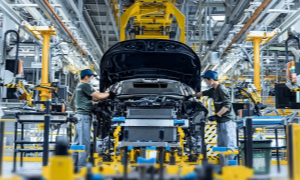
- Automated Production Lines: In the four major processes of automobile manufacturing—stamping, welding, painting, and final assembly—automated production lines have become the norm. For instance, stamping workshops employ high-precision servo presses and six-axis robots to achieve high-speed and high-precision stamping, significantly boosting production efficiency. Welding workshops utilize laser welding robots and flexible welding island systems to achieve high automation rates and mixed-line production of multiple vehicle models, substantially reducing model changeover times.
- Flexible Automation Technology: Flexible automation technology combines the advantages of numerical control and computer technologies, making automobile manufacturing equipment more intelligent and scientific. It can adapt to the production needs of different vehicle models, enabling rapid line changeovers and flexible production, thereby enhancing a company’s market responsiveness.
2. Ensuring Product Quality and Consistency
- High-Precision Machining and Assembly: Automation technology ensures the machining accuracy and assembly quality of components through precise automated equipment. For example, in engine machining, automated machine tools can achieve high-precision machining, ensuring stable engine performance. Simultaneously, automation technology enhances the traceability of the production process, facilitating quality control and problem troubleshooting.
- Automated Inspection Technology: Automated inspection technology plays a crucial role in automobile manufacturing. Advanced technologies such as machine vision and laser scanning are employed to comprehensively inspect components and finished vehicles, ensuring product quality meets standards. For instance, a new energy vehicle factory utilizes an AI defect recognition system that, through deep learning of numerous defect samples, can automatically classify various common quality issues with an accuracy rate of up to 99.7%.
3. Reducing Production Costs and Energy Consumption
- Minimizing Manual Operations: The application of automation technology significantly reduces manual operation links, lowering labor costs. Moreover, since automated equipment can operate continuously and stably, it minimizes production interruptions and waste caused by human factors, further reducing production costs.
- Energy Efficiency and Environmental Protection: In the painting process, automation technology reduces volatile organic compound (VOC) emissions by adopting advanced thin-film pretreatment processes and 3-WET spraying techniques, achieving environmentally friendly production. Simultaneously, automated drying equipment can adjust temperature curves based on the thickness of different vehicle body parts, reducing energy consumption.
4. Enhancing Production Safety
- Fault Prediction and Handling: Automation technology can detect potential faults in real-time by monitoring equipment status and the production process, issuing warnings promptly. Once equipment fails, the automated system can immediately cut off the power supply and sound an alarm, effectively protecting workers’ lives and minimizing equipment damage.
- Human-Robot Collaboration Safety: With the application of collaborative robots, human-robot co-assembly has become possible. Collaborative robots possess advanced perception and decision-making capabilities, enabling them to work closely with workers to complete production tasks while ensuring worker safety.
5. Promoting Intelligent and Digital Transformation
- Digital Twin Technology: Digital twin technology creates virtual factory models to simulate and optimize the production process in real-time. It helps companies identify potential issues in advance and develop solutions, improving production efficiency and product quality. For example, the “Digital Twin Assembly System” in a domestic new energy vehicle brand’s factory has revolutionized production by using IoT sensors to collect real-time data. The virtual factory can simulate the assembly process in advance, predicting and eliminating potential interference issues.
- Artificial Intelligence and Big Data: The application of artificial intelligence and big data technologies presents new opportunities for automobile manufacturing. By collecting and analyzing vast amounts of production data, companies can gain in-depth insights into production conditions and optimize production processes. Additionally, AI algorithms can be used for quality control, fault prediction, and intelligent decision-making, enhancing a company’s level of intelligence.